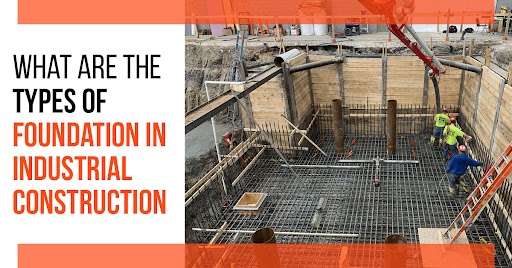
What Are The Types Of Foundation In Industrial Construction
Any industrial facility starts with a strong foundation as its basis. The most important factor in an industrial project is the foundation because the heavy machines, large structures, and complicated operations are all dependent on it for safety, stability, and durability. Throughout Chennai, construction companies in Chennai are heavily investing in foundation precision as their first step in building safety; every structure will be able to carry loads, be exposed to weather and fulfil its functions. Knowing different types of building foundation gives control and power to the project owners in decision-making, helps them in cost optimization and also assists in following the green building way.
1. Shallow Foundations
Usually, shallow foundations are put in place when the earth near the surface is strong enough to bear the weight of a building. They are the ones that directly transfer the load to the ground close to the surface and can be used for industries of light to medium strength.
Spread Footings: These are the areas of soil that are shaped in either square or rectangular form and help the columns to distribute their load in an even manner. They are the most appropriate for the warehouses and the small-scale industrial units.
Strip Footings: These types of foundations are extended continuously under the load-bearing walls and are perfect for buildings with linear layouts.
Raft or Mat Foundations: It is a huge slab which covers the entire area of the building and ensures the uniform distribution of the load. With a low soil bearing capacity, rafts are the right choice for industrial sites.
Shallow foundations are money-saving and quicker in terms of construction and, therefore, are the most popular ones among the industrial sector.
2. Deep Foundations
When the surface soil is weak, or the structure is very heavy, deep foundations must be used. These foundations basically transfer the loads to deeper, more stable layers of soil or rocks.
Pile Foundations: Several long, circular, concrete, steel, or timber pieces are driven deep into the earth to provide support to heavy industrial structures. Piles are the best choice for large industrial buildings, high-rise industrial structures, or structures that are close to water bodies.
Caisson Foundations: Large, airtight structures that are sunk into the ground and later filled with concrete. Caissons can be described as the most appropriate heavy industrial constructions which have to be deeply supported, for example, power plants or storage facilities.
Deep foundations are less economical and require more time to install; however, they are indispensable in ensuring the safety and first-class quality of industrial projects that are complicated.
3. Combined or Hybrid Foundations
There are scenarios where industrial projects need both shallow and deep foundations. Hybrid foundations are created considering load distribution, soil conditions, and the structure’s needs.
It is possible that a manufacturing plant with large machines on one side and a small office space on the other will have deep foundations under the areas with heavy loads and shallow foundations under the lighter parts. In this way, the company saves money and time on construction while still being able to guarantee stability throughout the plant.
4. Specialized Foundations
Some industrial projects, for example, those requiring foundations built for certain functions or conditions, have to be specially taken care of. These are:
- Floating Foundations: It is a kind of foundation that can be found in places with weak or compressible soils, where the weight of the building is counterbalanced by the process of digging and then replacing the soil to reduce settlement.
- Isolated Foundations: The ones that are used only for the individual columns in which the loads are concentrated.
- Machine Foundations: The main purpose of the design of these is to be able to absorb the vibrations coming from the heavy machinery, and also they are capable of minimizing the structural impact.
Specialized foundations are very accurate engineering works, and often they can be production practice to sustain the environment by introducing reinforced concrete and locally sourced materials to reduce the environmental impact.
Factors Influencing Foundation Choice
The kind of foundation used is mainly influenced by the following factors:
- Soil Type and Bearing Capacity: These factors decide if the foundations will be shallow or deep.
- Load Requirements: For example, heavy industrial structures generally use pile or caisson foundations.
- Environment: The underground water levels, earth tremors, and even the wind blowing in a certain direction can all be used to figure out the building design.
- Money and Time: Shallow foundations can be installed at a lower cost and in less time, while deep foundations are more expensive and take longer to be installed.
By considering these points, industrial construction crews not only get the best foundation results but also are able to fulfil their green construction goals.
Importance of Proper Foundation Construction
Properly built foundation facilitates:
- Durable structural stability
- Ability to withstand soil changes and uneven ground
- Security of heavy machines and industrial processes
- Money saving throughout the building lifespan
Not thinking about the foundation stage may lead to expensive fixings, wastage of time, or in the worst case, the sudden collapse of the structure, which is why professional knowledge is indispensable.
The foundations are the support system of any heavy-duty project, and making the right choice of the type is the main thing for safety, longevity, and saving of resources. It is a matter of different depths of the foundations, from shallow footings to deep piles, each with certain soil and load conditions. At Sathlokhar, we merge exactness in engineering and environmentally friendly construction methods to be strong in the foundation construction phase. As the most reliable commercial builders in Chennai, we pledge that each of your projects will be on the firm, dependable ground which is constructed not only for the current needs but also for future expansion.